
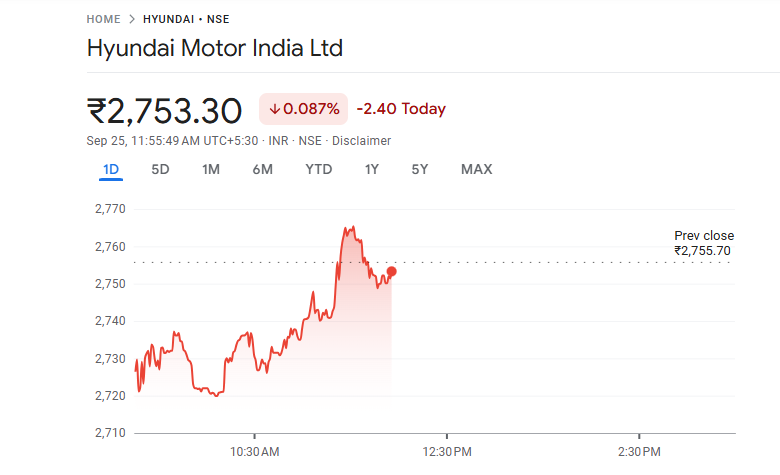
Hyundai Motor India share price
As of the latest data, Hyundai Motor India is trading around ₹2,544.45 on the BSE/NSE. Over the past 52 weeks, the stock’s low was approximately ₹1,542.95 and its high near ₹2,624.30.
Its P/E ratio stands in the range of ~36‑38, and the market cap is over ₹2,00,000+ crore. Given these metrics, the stock has already delivered strong gains in recent months, but analysts (notably Nomura) see room for further upside based on key drivers.
Context: Why Nomura Is Bullish
In a recent report, Nomura reaffirmed a “Buy” rating on Hyundai Motor India, maintaining a target price of ₹2,846, implying ~4.5 % upside from current levels.
Nomura highlights three structural levers that could drive the stock higher:
- GST Rate Cut / Policy Tailwinds
- Strong New Product Launch Pipeline
- Rising Export Mix & Margin Upside
Let’s delve deeper into each.
1. GST Cut & Favorable Tax Regime
What’s happening with GST
The Indian government has recently reworked GST slabs for automobiles, especially small cars and compact segments. After this cut, models that earlier attracted 28 % GST could now fall under an 18 % slab, making them more affordable.
Hyundai is well positioned in segments that may benefit (compact SUVs, small / mid-size cars).
Implications for Hyundai
- Increased demand: Lower tax burden could stimulate consumer interest, especially in price-sensitive segments.
- Volume uplift: As affordability improves, Hyundai may see higher bookings & sales in compact and niche models.
- Competitive edge: It could pressure competitors to pass on GST benefits, and those who don’t might lose market share.
Nomura also notes that following the GST reduction, there has already been a ~50 % jump in bookings for Hyundai in recent days.
Risk note: One caveat is that Hyundai received GST notices worth ~₹17.5 crore, which had dented sentiment earlier.
2. New Product Launch Momentum
A strong model pipeline is central to the bullish thesis.
What Hyundai plans
- Hyundai has guided for 26 new launches in India by 2030, which include fresh nameplates and refreshed versions of existing ones.
- The mix is aimed at capturing rising demand in premium SUVs, electrification, and value-driven segments.
- An increasing share of SUVs (higher-margin models) is expected to help the company improve its overall margin profile.
Why this matters
New launches help Hyundai stay relevant, fight competition, and capture shifts in consumer preferences (towards SUVs, newer technologies, features).
Also, refreshed models reduce the risk of product obsolescence, particularly given fast-paced tech / regulatory changes (e.g. for emissions, safety, EV adoption).
If Hyundai times its launches right (especially when GST tailwinds are favorable), it can generate significant incremental revenue and margin expansion.

3. Rising Exports & Margin Leverage
Nomura places considerable weight on Hyundai’s ability to grow its export mix and benefit from margin arbitrage.
Export growth potential
- Globally, Hyundai aims for 5.5 million units by 2030; India is expected to contribute ~15% of that.
- Domestically, Hyundai expects its export share to rise from ~22% in FY25 to ~30% by 2030.
- Rising exports mean better utilisation, scale benefits, and possibly better margins (depending on the pricing and cost structure).
Margin leverage
Nomura expects exports to deliver stronger margins relative to domestic sales. That means as export volume share increases, overall blended margins should improve.
They project a 27% EPS CAGR over FY26–28 for Hyundai India, driven by these structural levers.
In short: volume growth from exports + favorable margin mix = strong earnings growth potential.
Risks & Headwinds to Watch
While the case is promising, there are risks that could derail the upside:
- Raw material / commodity inflation: If input costs rise sharply, Hyundai might struggle to absorb them fully.
- Execution risk in launches: Delays, regulatory approvals, quality issues, or weak reception could hurt sales.
- GST rollback or policy uncertainty: If the government revises taxes unfavorably, it could reverse benefits.
- Global macro & currency risk: For exports, forex fluctuations or global demand shocks could hurt margins.
- Competition & pricing pressure: Aggressive discounting from rivals might erode margins.
Regulatory / legal liabilities: E.g. prior GST notices, compliance issues. As seen, Hyundai had a GST notice ~₹17.5 crore in 2025.
Conclusion
Hyundai Motor India is trading at strong multiples already, but with tailwinds from a recent GST cut, a robust new model pipeline, and export growth potential, analysts like Nomura see further upside. The three pillars—policy benefit, product launches, and margin leverage—form a cohesive growth narrative.
However, success hinges on execution, cost control, and external macro factors. For investors, Hyundai offers a mix of opportunity and risk. If you’re considering investing or writing more on this, you might want to monitor quarterly results, launch updates, and policy announcements closely
✅ Main Keywords:
- Hyundai Motor India share price
- Hyundai India stock forecast
- Hyundai GST cut impact
- Hyundai new launches 2025
- Nomura Hyundai Motor India